All Inclusive Switzerland Holidays 5 Days No Hidden Costs
Switzerland may look compact on a map, but a carefully planned 5-day route can still deliver snow-dusted peaks, polished cities, lake promenades, and legendary train rides without turning the trip into a blur. That matters for travelers with limited vacation days and a close eye on spending. In a country where prices can surprise first-time visitors, structure is not just convenient; it is financial protection. This guide lays out a practical itinerary that balances scenery, transport efficiency, and clearer budgeting from arrival to departure.
Outline and Planning Basics for a Transparent 5-Day Switzerland Tour
A short Swiss holiday works best when it follows the grain of the country rather than fighting it. Trains are fast, stations sit in the middle of cities, and distances that look dramatic on postcards are often manageable in real life. Zurich to Lucerne is usually under an hour by rail. Lucerne to Interlaken on the panoramic Luzern-Interlaken Express takes roughly 1 hour and 50 minutes. Zermatt to Geneva is longer, but still realistic for a final travel day. That is why a 5-day trip can include several signature experiences without feeling frantic, provided you avoid unnecessary backtracking.
The phrase “no hidden costs” should be understood in a sensible way. It rarely means every coffee, cable car, and souvenir is prepaid. What it should mean is that the main expenses are clear before departure. In Switzerland, travelers are often caught out by small but repeated charges such as city taxes, mountain railway supplements, seat reservations on certain scenic services, minibar prices, and restaurant bills that rise quickly once drinks and desserts are added. A strong package, or a self-built all-inclusive-style plan, normally includes accommodation, breakfast, intercity transport, and at least one major excursion. The more precise the inclusion list, the easier it is to compare offers.
Here is a practical outline for the five days:
• Day 1: Arrive in Zurich and continue to Lucerne for an easy first evening.
• Day 2: Travel to Interlaken and spend the day in the Jungfrau region.
• Day 3: Move west through Bern or directly toward Lake Geneva, finishing in Montreux or a nearby lakeside base.
• Day 4: Head to Zermatt for Matterhorn scenery and a mountain railway experience.
• Day 5: Travel onward to Geneva for departure or a final city visit.
Compared with renting a car, trains usually make more sense on a fast itinerary. Parking in city centers is expensive, mountain roads can be tiring after long travel days, and some of the most famous resorts, including Zermatt, are car-free anyway. The Swiss Travel Pass is often convenient because it bundles many train, bus, and boat journeys and can also include museum entry, while point-to-point tickets may be cheaper for travelers who lock in specific times well in advance. For hotels, a mid-range standard is the safest fit: clean, central, breakfast included, and close enough to the station that luggage does not become its own sightseeing activity. Think of the trip as a chain of smooth handoffs rather than a race, and Switzerland becomes far more approachable than its luxury reputation suggests.
Day 1: Zurich Arrival and Lucerne’s Easy Introduction to Swiss Travel
For many international visitors, Zurich is the natural gateway. Its airport is efficient, the rail connection into the city is quick, and onward trains depart frequently. If your flight lands early, spend a few hours in Zurich before continuing to Lucerne. That contrast is useful: Zurich gives you the modern, financially powerful face of Switzerland, while Lucerne delivers the postcard version many travelers expect. In Zurich, the old town stretches along the Limmat River with church towers, elegant shop fronts, and streets that feel orderly without becoming sterile. Bahnhofstrasse is famous for luxury retail, but even if you are not there to browse watches, it offers a glimpse of the polished urban identity that helped make Zurich one of Europe’s most prosperous cities.
Still, Lucerne is usually the better overnight stop on a 5-day route. The direct train ride is short, generally around 45 to 50 minutes, and the city is more compact for a first evening when travelers may be tired from flying. Lucerne’s core attractions are easy to reach on foot: the Chapel Bridge, the Reuss River embankment, the Lion Monument, and broad views over Lake Lucerne. Compared with Zurich, which feels larger and more businesslike, Lucerne invites a slower rhythm. You can walk from the station to the waterfront in minutes, hear boat horns drifting over the lake, and watch the evening light soften the façades of historic buildings. It is the sort of arrival that quietly resets a jet-lagged brain.
For budgeting, the first day is where good habits begin. Consider these common spending points:
• Airport snacks and coffee can cost far more than supermarket alternatives.
• Hotel city taxes may be added separately at check-in.
• Premium room upgrades with lake views can change the nightly rate sharply.
• Local transport may be included with a visitor card, but not always.
If your package includes breakfast and rail transfer, you have already covered two of the most practical expenses. A simple dinner in Lucerne can still vary widely in price, so many savvy travelers mix one restaurant meal with groceries from Coop or Migros. That approach is not unromantic; it is realistic. Save the larger splurge for a mountain excursion later in the trip, when the views do more than the menu to justify the cost. If energy allows, end the day with a lakeside walk. Boats slide across the water, mountains gather in the distance like a promise, and the country begins to feel less like a dream image and more like a place you can actually navigate.
Day 2: Interlaken and the Jungfrau Region, from Big Alpine Drama to Smarter Choices
The second day is where Switzerland starts performing at full volume. The Luzern-Interlaken Express is not merely a transfer; it is an attraction in its own right. The line threads past lakes, climbs through the Brünig area, and reveals the countryside in slow, cinematic layers. If day one introduced the country through urban form and lakefront charm, day two opens the curtain on a grander stage. Interlaken sits between Lake Thun and Lake Brienz, and its location makes it a hub rather than a destination to rush through. From here, travelers fan out toward Lauterbrunnen, Grindelwald, Wengen, Mürren, and Jungfraujoch depending on budget, weather, and appetite for altitude.
The headline option is Jungfraujoch, often marketed as the “Top of Europe.” At 3,454 meters above sea level, it is home to Europe’s highest railway station and offers a high-alpine setting that feels almost unreal in clear weather. The trip is memorable, but it is also one of the costliest single excursions in the country, especially if not discounted by a rail pass or package. That is why comparison matters. For many travelers, the villages and mid-mountain viewpoints in the Jungfrau region provide a better balance of value and beauty. Lauterbrunnen offers one of the most dramatic valley settings in Europe, hemmed in by vertical cliffs and waterfalls. Wengen is calmer and traffic-free, with a classic chalet atmosphere. Grindelwald is busier and more activity-focused. Mürren feels more suspended from the world, like a shelf built into the mountains.
A useful way to choose is to match the excursion to your travel style:
• Pick Jungfraujoch if this is a once-in-a-lifetime visit and you want the iconic high-altitude experience.
• Choose Grindelwald and First if you prefer flexibility, village atmosphere, and optional adventure activities.
• Go to Lauterbrunnen and Wengen or Mürren if your priority is scenery over prestige.
Compared with staying in Lucerne, Interlaken is less intimate, but it wins on access. That access has practical value because one missed connection in a short trip matters. Be alert to extra charges here: mountain railways often require supplements, weather can force last-minute changes, and food prices at summit restaurants are rarely gentle. One smart strategy is to pack a picnic from a supermarket before heading uphill. Another is to confirm whether your ticket covers only the base route or the full mountain ascent. In Switzerland, the difference between “included transport” and “included excursion” can be substantial. Yet when clouds part and the Bernese Alps appear above green meadows and toy-like villages, even a careful budget starts to feel like money well translated into memory.
Day 3: Bern, Scenic Rail Comparisons, and the Shift Toward Lake Geneva
By the third day, the itinerary benefits from a change in tone. After mountain spectacle, Switzerland’s cities show why the country is more than a landscape gallery. Bern is an excellent stop because it feels different from both Zurich and Lucerne. It is the federal capital, but it does not move with the sharp commercial tempo of Zurich. Instead, Bern has arcaded streets, sandstone buildings, and a calm, almost deliberate dignity. Its Old Town is a UNESCO World Heritage Site, and the Zytglogge clock tower, Bear Park, and views from the Rosengarten give first-time visitors enough substance for several hours without creating itinerary overload. If Zurich feels sleek and Lucerne feels romantic, Bern feels settled, civic, and quietly confident.
There are two good ways to shape this day. The first is the efficient option: travel from Interlaken to Bern in under an hour, store luggage in station lockers, explore the center, then continue to Montreux or Lausanne by regular train. The second is the more scenic alternative: skip Bern and take the full GoldenPass route from Interlaken toward Montreux. The GoldenPass line is celebrated for its changing scenery, moving from alpine landscapes through rolling countryside into the softer, vineyard-lined world of western Switzerland. It is one of the best examples of how the country changes character over relatively short distances. The eastern and central regions often feel crisp and vertical; Lake Geneva introduces a broader, more Mediterranean mood.
Montreux is a strong overnight choice because it places you on the lake with easy onward access. The promenade is elegant, Chillon Castle is nearby, and the Lavaux vineyard terraces can be visited if time permits. Lausanne is more urban and youthful, helped by its universities and steeper street life. Geneva is more international, with diplomatic institutions and a cosmopolitan edge. For a 5-day route, Montreux or Lausanne usually offers a more relaxed midpoint before the jump to Zermatt.
This is another day when transparent planning matters:
• Scenic trains may involve seat reservation options that are not always covered by the base fare.
• Luggage storage at stations is convenient but adds to the daily total.
• Lakefront hotels often command a premium over properties a few blocks inland.
• Short stopovers are rewarding only if station proximity is part of the hotel and train plan.
What makes day three special is its range. One moment you are under medieval arcades in Bern; a few hours later you are beside vineyards and a broad lake that seems to hold the sky in place. Switzerland’s reputation often rests on mountains alone, but this transition proves that texture, not just altitude, is what makes the country so compelling.
Day 4: Zermatt, the Matterhorn, and Choosing the Right Mountain Experience
Zermatt is the point in the trip where even seasoned travelers tend to reach for their cameras more often than usual. The village is car-free, which immediately changes the mood. Electric taxis hum quietly, streets stay comparatively calm, and the mountains appear close enough to rearrange your sense of scale. Getting there from the Lake Geneva area is part of the experience, usually via Visp, and the final approach into the valley has a narrowing, anticipatory quality. You feel the country gathering itself for a finale. Zermatt is not the cheapest stop on any Swiss itinerary, but it is one of the most memorable, and that is why it earns a place on a 5-day highlights route.
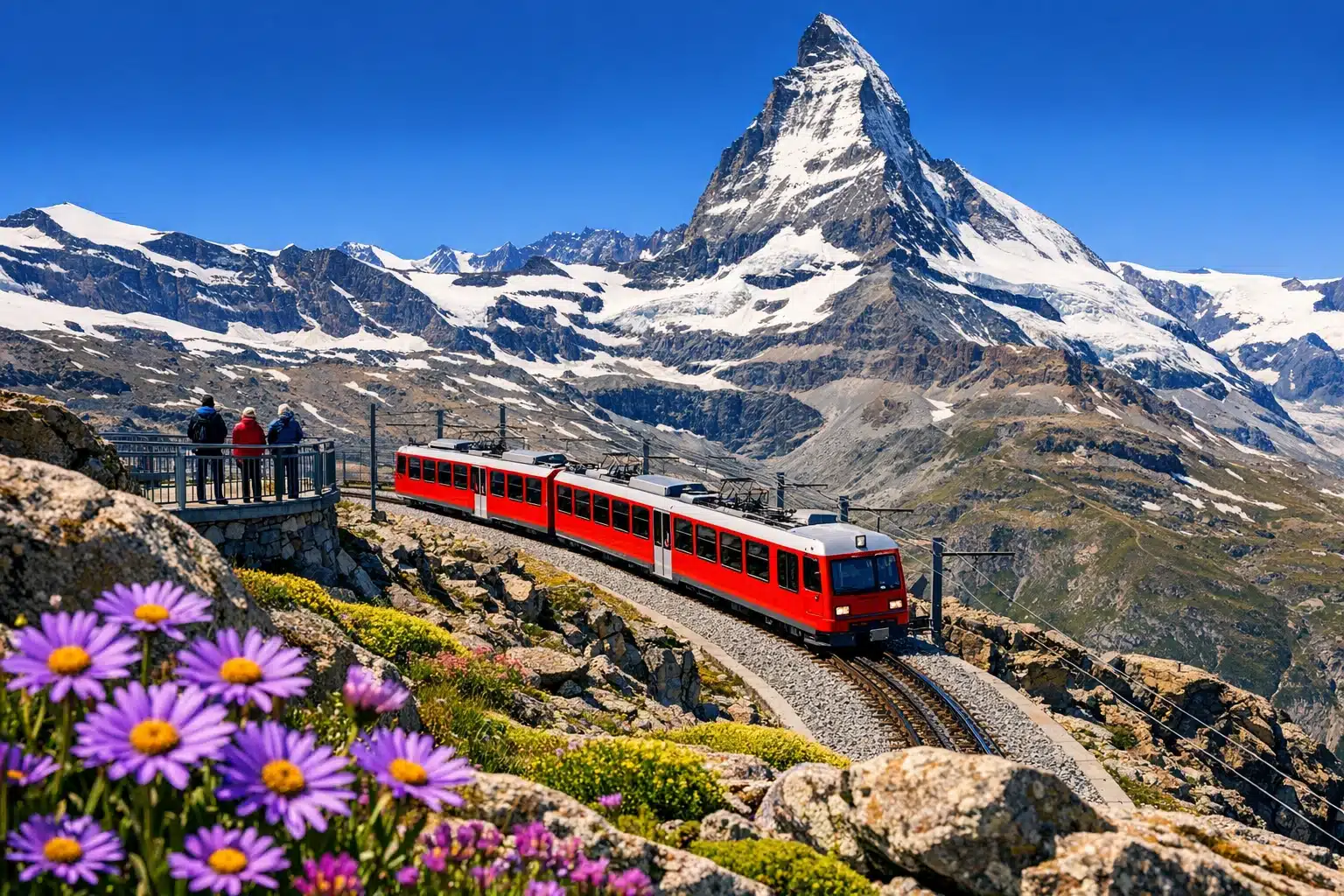
The key decision is which mountain railway to prioritize. Gornergrat is often the strongest all-round choice. The cogwheel train climbs to a superb panoramic platform with views over the Matterhorn and surrounding peaks, and the journey itself is part of the attraction. Matterhorn Glacier Paradise, reached by cable car, takes you higher and offers a more dramatic sense of altitude, but it can be more expensive and may feel less grounded in the railway heritage many visitors associate with Switzerland. For travelers watching costs, Gornergrat often gives the better ratio of scenery to spending. If weather is poor, consider focusing on the village, local museums, and short walks instead of forcing an expensive ascent into cloud.
Zermatt also shows how “all inclusive” can mean different things in practice. Some packages cover the rail journey to town and the hotel, but not the mountain excursion. Others include one ascent but only on a selected line or only during certain hours. Read the details carefully. Typical extras may include:
• Peak transport supplements beyond the standard ticket or pass.
• Spa access fees in some higher-end hotels.
• Luggage transfer services from the station.
• Restaurant pricing that rises noticeably in central, view-heavy locations.
Despite that, Zermatt is not only for luxury travelers. A modest hotel, an included breakfast, and one well-chosen mountain ride can still produce a rich experience. In the early morning or near sunset, the village often feels like a stage set after the crowd noise drops. Rooflines sharpen, cold air settles in, and if the Matterhorn reveals itself cleanly, the mountain looks less like a landmark and more like a symbol condensed into rock. Few places justify a careful splurge as convincingly as this one.
Day 5: Geneva Departure, Final Practical Tips, and How to Keep Costs Predictable
The final day is usually shaped by departure logistics, but Geneva deserves more than a quick airport transfer if your schedule allows it. The train ride from Zermatt to Geneva often takes around four hours, which is long enough to remind travelers how varied the country really is. You leave a tight alpine valley, descend through the Rhône corridor, and arrive in a city whose identity is international rather than resort-based. Geneva is home to global organizations, diplomatic missions, lakefront promenades, and a blend of French-speaking Swiss culture that feels distinct from the German-speaking cities earlier in the route. Compared with Lucerne’s compact charm or Zermatt’s mountain focus, Geneva is broader, more outward-looking, and more metropolitan.
With half a day, you can still build a satisfying finale. Walk near the Jet d’Eau, explore parts of the Old Town, or head toward the lakeside parks for an easy closing chapter. If your flight is later in the day, Geneva’s excellent rail link to the airport makes a city stop realistic. If it is earlier, staying near the station or airport the night before may be the wiser move. On a 5-day itinerary, convenience is often worth more than squeezing in one extra attraction. Missed flights are the ultimate hidden cost.
The last day is also the right moment to review where travelers most often overspend:
• Booking a package without checking whether mountain lifts are fully included.
• Assuming lunch and dinner are part of the hotel arrangement when only breakfast is covered.
• Forgetting city taxes, reservation fees, or the price of airport transfers.
• Choosing scenic upgrades impulsively without comparing them with standard trains that use similar routes.
If you want the cleanest possible budget, ask for an itemized breakdown before booking anything. Separate the total into accommodation, intercity transport, local transport, mountain excursions, meals, and taxes. That makes comparison easier across agencies, rail passes, and self-built trips. Switzerland is expensive, but it is rarely chaotic. Once the numbers are visible, the country becomes surprisingly manageable.
There is a final charm to ending in Geneva. The trip begins with precise planning and then unfolds into lakes, ridgelines, old towns, and windows full of passing green. By the time you reach the western edge of the country, the itinerary no longer feels like a checklist. It feels like a compact narrative, one that gives first-time visitors enough variety to understand why Switzerland continues to attract travelers who value both natural beauty and functional ease.
Conclusion for Travelers Seeking a Smart 5-Day Swiss Holiday
A 5-day tour of Switzerland is most rewarding for travelers who want variety without wasting time on complicated logistics. This route works because each stop adds a different side of the country: Zurich introduces efficiency, Lucerne softens the pace, Interlaken opens the mountain world, Bern and Lake Geneva broaden the cultural picture, and Zermatt delivers the iconic alpine finish. For couples, solo travelers, and first-time visitors especially, the real advantage is not trying to “do everything,” but choosing places that connect smoothly by rail and justify the time spent moving between them.
If the title idea of “no hidden costs” matters to you, the best strategy is not blind trust in a label but careful attention to inclusions. Ask what meals are covered, whether mountain transport is part of the price, and if taxes or seat reservations are extra. Build in one or two planned splurges, then keep the rest of the trip simple and well timed. Switzerland rewards organization with unusually high comfort, stunning scenery, and transport that helps rather than hinders the experience. Done well, five days here can feel not rushed, but expertly condensed.